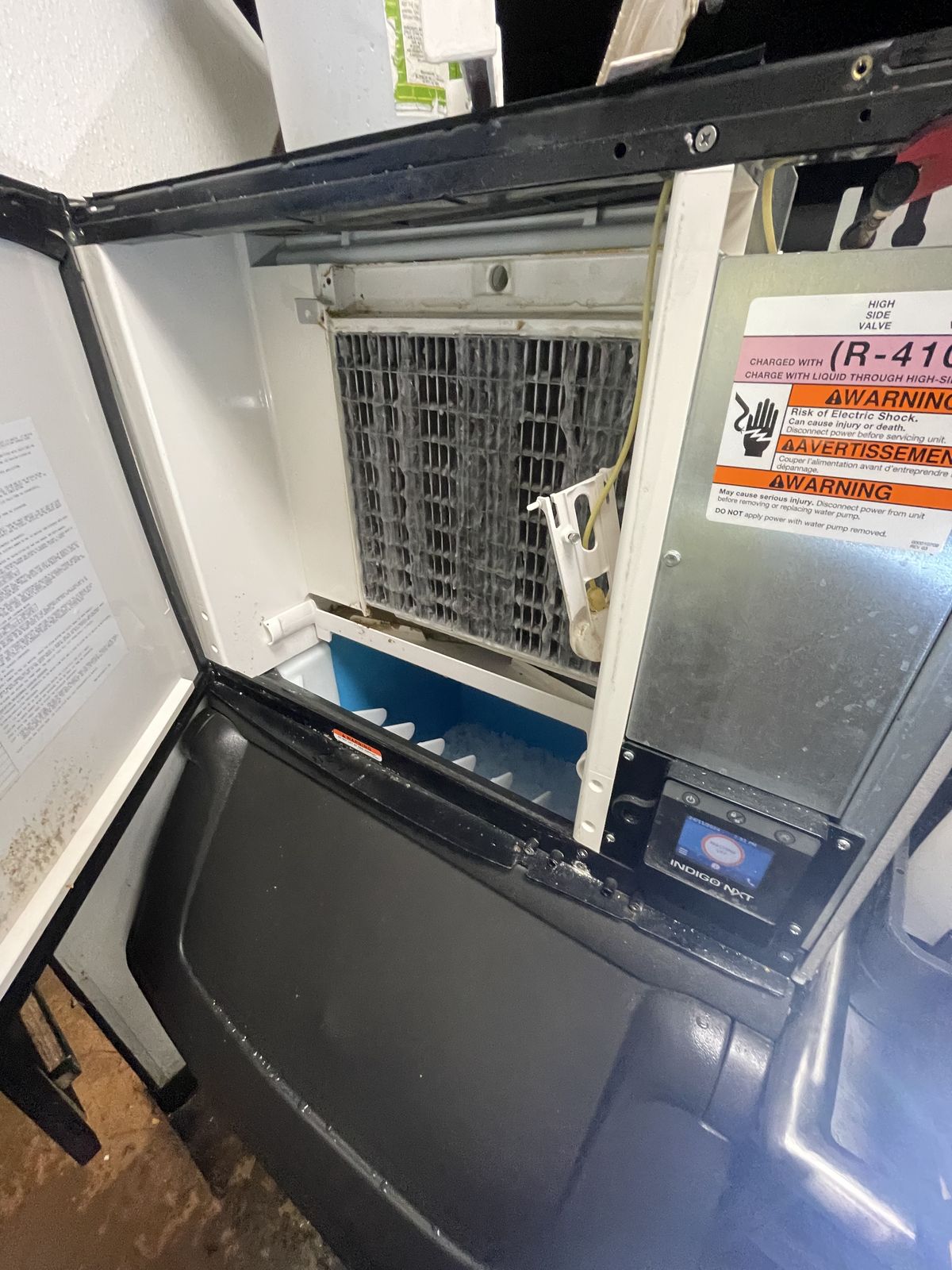
Instead of tidy cubes you've got drama: water overflowing the mold and cascading into the bin, a bin fused into one archaeological block, or a glacier slowly claiming the whole ice-maker corner. All three are versions of the same story — the fill side has lost its manners — and the sort order below finds the culprit fast.
The valve that won't quite close
The inlet valve is a spring-and-solenoid gate, and when debris or mineral scale props its seat open even slightly, it weeps between cycles. The weep has two signatures: drips that freeze where they land — building the berg in the bin and the icicles under the maker — and, in slower form, hollow frosty growth around the fill tube. In our hard-water valley, scale on the valve seat is the leading cause; the valve is a modest, same-visit part, and replacing it also resets the clock on the low-flow problems the same scale causes.
The fill that's simply too generous
Water arriving in a proper burst but overtopping the mold each cycle points at fill calibration: low house pressure making the timed fill run long (the valve compensates poorly below spec pressure), a fill adjustment drifted on models that have one, or a control board timing the pour wrong. The distinction from a weeping valve: overfill happens only during harvest cycles; a weep never stops. A pressure reading at the fridge is part of any honest overflow diagnosis.
The ejector mid-yawn and the sensor that lies
If the mold overflows because it was already full of ice when new water arrived, the ejector rake stalled mid-harvest — a module fault — or the cube-full level sensor (a feeler arm on classic makers, an optical or thermistor sensor on newer ones) is stuck reporting "empty," so the maker keeps producing into a full bin until physics objects. An arm merely flipped up by a bag of peas costs nothing to fix; a failed sensor or module swaps as a unit.
Meanwhile, stop the glacier
Shut the ice maker off (arm up, or the switch/menu toggle), empty and thaw the bin, and clear visible ice from the mechanism — but skip the hair-dryer heroics near plastic and wiring. The berg is a symptom; without fixing the weep or the sensor it regrows in a week. One fixed-quote visit across Boise, Meridian, Eagle and the valley: valve, pressure, sensor and module tested in that order, and the bin goes back to holding cubes instead of a monument.