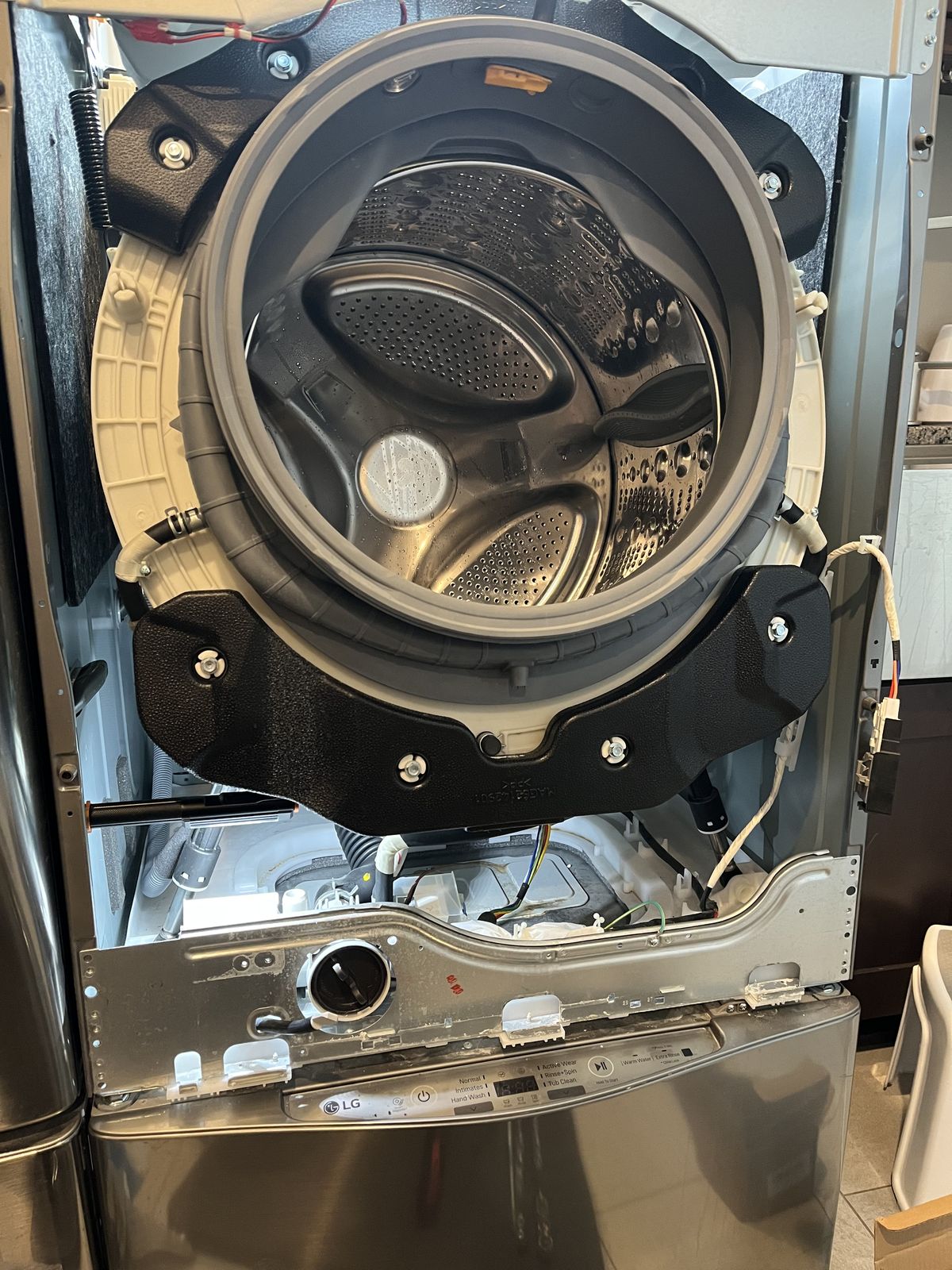
You pull a basket off the machine and your sock finds the puddle first. Water under a washer is the appliance complaint with the highest hidden-cost potential — not because the parts are expensive (they mostly aren't), but because subfloors keep secrets. The good news: when the machine leaks tells you what is leaking, and you can run that test yourself with a flashlight and one cycle.
Leaks only while filling: the supply side
Water appearing in the first minutes points behind the machine: fill hoses (the washers inside their fittings flatten with age; rubber hoses bulge before they burst — braided stainless replacements are cheap insurance), the inlet valve body weeping where the hoses land, or a house shutoff dripping down the wall so it merely looks like the washer. In our hard-water valley, scale crusting a valve's seat is a common reason it can't quite close — a slow, patient drip that runs even when the machine is off. That last detail is the giveaway: puddle grows overnight = supply side, guaranteed.
Leaks during wash or agitation: the tub circuit
Mid-cycle water means it's escaping the wash path: on front-loaders the door boot (check the folds for a pinhole or an old sock working as a wedge), on top-loaders the tub-to-pump hoses and the air-dome fittings, or oversudsing — too much detergent literally pushes foam past seals, and hard-water dosing habits make this a genuinely common false alarm here. One properly dosed cycle settles whether you have a leak or a chemistry experiment.
Leaks at drain or spin: the pump and its plumbing
Water arriving exactly when the machine drains convicts the drain pump — a cracked housing, a failed shaft seal, or the clamp on its hoses — or the drain hose itself chafed through where it rubs the cabinet. Pumps are stocked, standard-cost, same-visit parts.
The one leak with a bigger conversation
Water from the center underneath during wash and spin, often with a growing roar in the background, points at the main tub seal and bearings — the deep-anatomy job. On a newer machine it's worth doing; on an aging one we'll show you the math before anyone commits, because that's an honesty checkpoint, not an automatic sale.
Don't let it marinate
A teaspoon per load becomes a rotted subfloor by spring, and in Meridian and Eagle two-story homes the laundry room is upstairs more often than not. Towel down, run the timing test, and bring us the answer — it usually means the right part is on the van for a one-visit, fixed-quote fix.