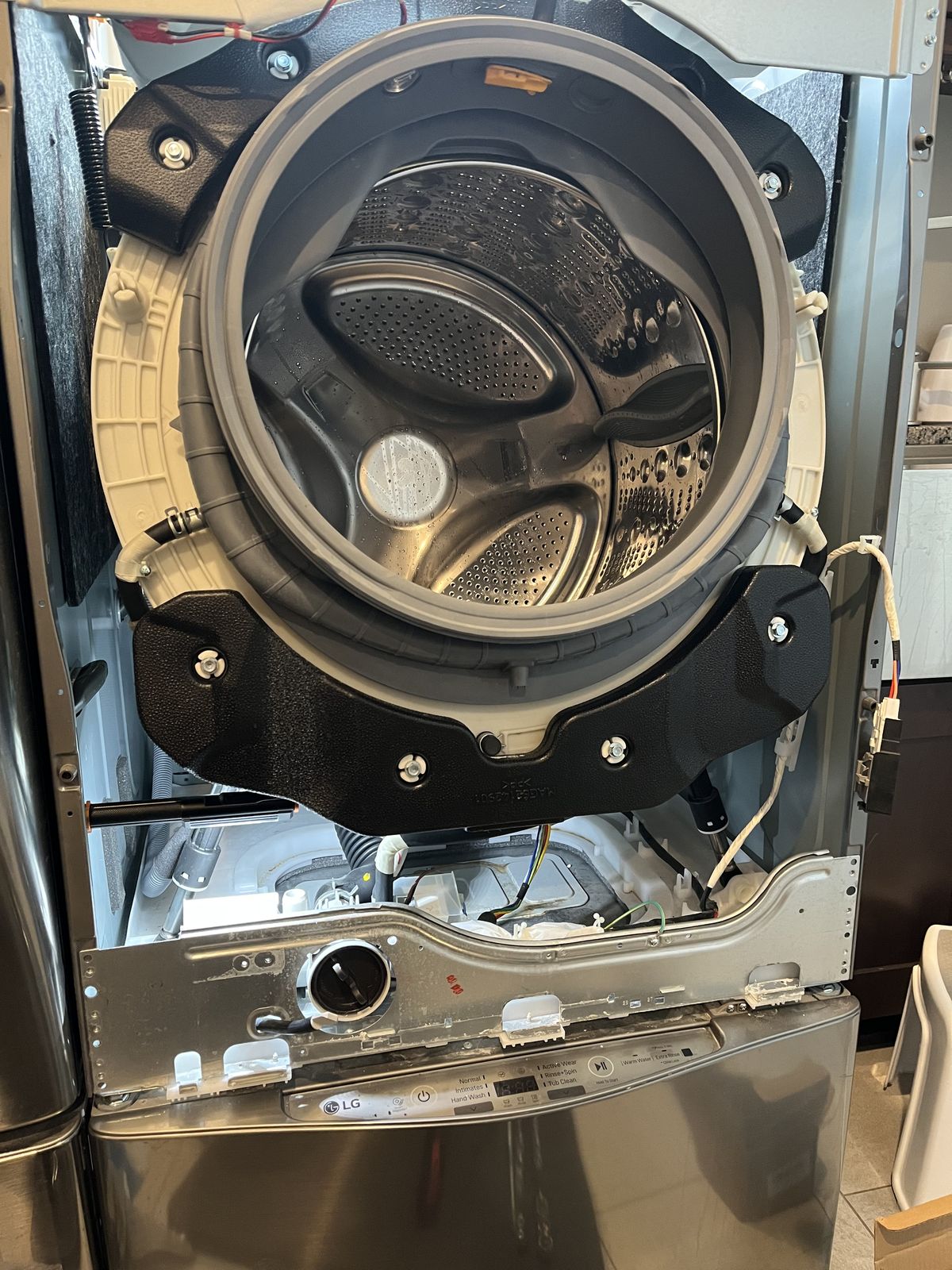
The cycle says done; the towels say otherwise — wringing wet, twice their weight. "Won't spin" splits into three distinct failures, and the machine tells you which one you have by what it does (and sounds like) at spin time. Sort that first and the repair gets short.
First, the rule the machine lives by: drain before spin
No washer will spin a tub it believes is still full. If water is standing with the clothes, you don't have a spin problem — you have a drain problem (pump, filter, hose), and the spin refusal is just the machine obeying its own safety logic. Wet clothes with no standing water: read on.
Version one: the drum never spins at all
Top-loaders: the lid switch or lock is the career suspect — the machine washes but refuses the high-speed act with an "open" lid; listen for the missing click, look for a lock light blinking. Older agitator machines add the famous motor coupler, a sacrificial plastic link that shears (wash works, spin hums, drum stationary — textbook). Front-loaders and belt-drive machines: a snapped or slipped belt — the motor whirs happily while the drum ignores it. All three are modest, same-visit parts.
Version two: it spins, but lazily, and clothes stay heavy
A slipping belt, a weakening motor, or on direct-drive front-loaders a fading rotor/hall-sensor conversation — the drum turns but never hits the RPM that actually throws water out. Sometimes it's simpler: a partially restricted drain (that coin-trap filter again) slows extraction, and the machine finishes on the clock with the job half done.
Version three: it tries, shakes, gives up
The machine accelerates, senses an off-balance load, redistributes, tries again, and eventually aborts — often with an unbalance code. One soaked comforter or bathmat can cause this innocently. But when every load triggers the dance, the suspension has worn out: shocks on front-loaders, suspension rods on top-loaders — the machine can no longer damp a normal load, so it protects itself by refusing speed. Routine suspension work, transformative results.
The visit
Tell us which version you have when you book — it usually means the right part rides along on the first trip. Meter and hands-on the suspects, one fixed written price, and same-visit completion for the common failures across Boise, Meridian, Nampa and the rest of the valley. Your towels go back to coming out merely damp, the way physics intended.